What TMCs Need From Modern Travel Software
Travel management companies do not just need software that helps people book travel.
They need software that helps them run and grow client travel programs properly.
That is a very different requirement.
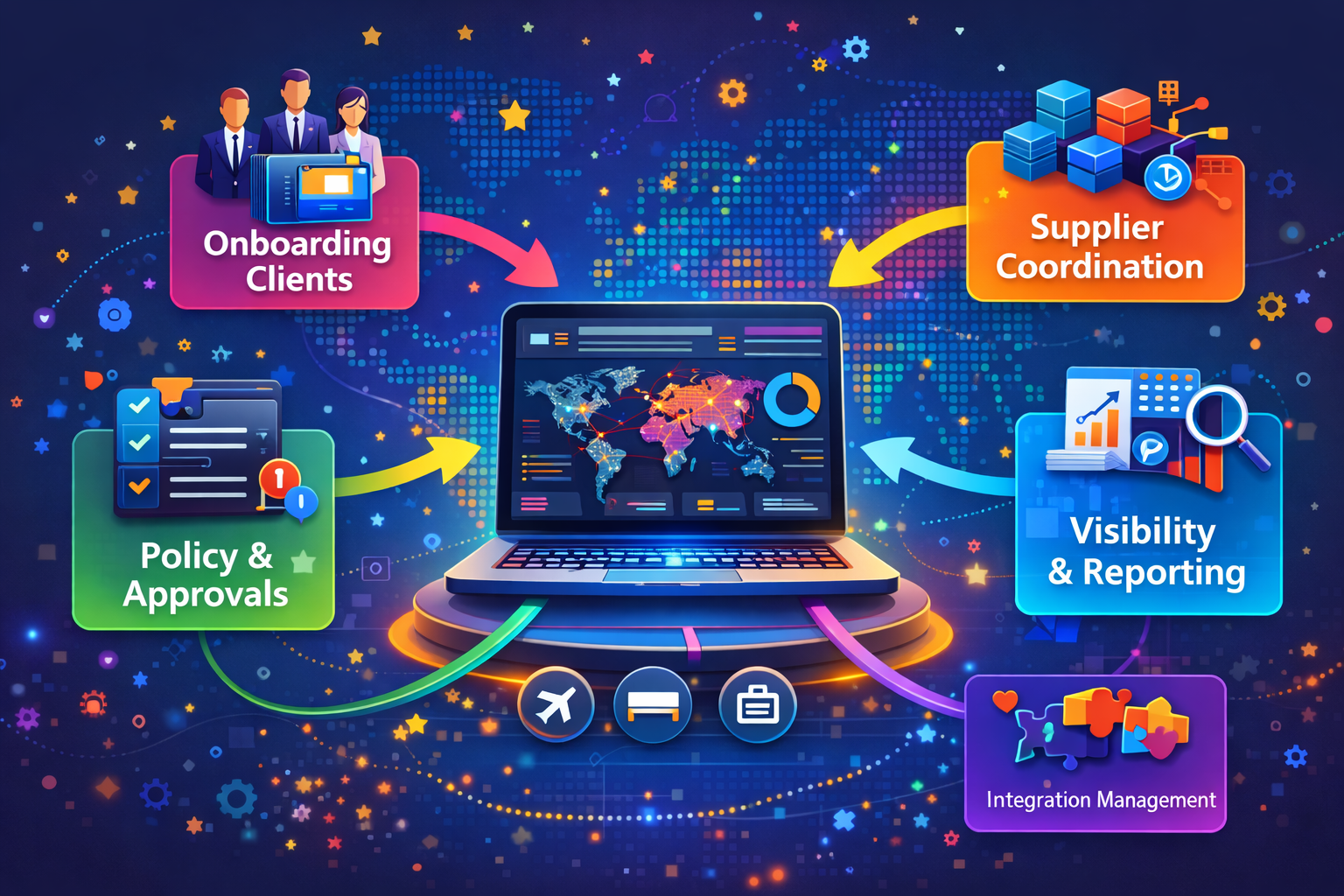
A TMC is not only handling transactions. It is onboarding clients, managing policies, supporting approvals, handling exceptions, coordinating suppliers, maintaining visibility, producing reports, and delivering a service model that clients can trust. The software behind that work needs to support more than bookings. It needs to support operations.
That is one of the reasons Cinturon360 is being built with TMCs at the centre of the product story.
The old expectation is no longer enough
For a long time, travel software conversations have often focused too heavily on booking capability.
Can content be accessed?
Can a trip be reserved?
Can the traveller complete the booking flow?
Those things matter, but they are not the full picture for a TMC.
A TMC also needs to know:
- how the client is set up
- what policy rules apply
- who needs to approve what
- how exceptions should be handled
- what reporting the client expects
- what finance needs to receive
- which channels and integrations are in play
- how the agency can service the account consistently at scale
That is where many travel technology stacks still fall short. They support pieces of the workflow, but not the TMC operating model as a whole.
TMCs need software that helps them manage clients, not just bookings
A modern TMC platform needs to treat client management as a first-class capability.
Every client can have its own:
- approval structures
- travel policies
- reporting expectations
- servicing rules
- financial requirements
- booking channel mix
- integration needs
- governance maturity
That creates real complexity for the TMC.
Without the right platform, that complexity often gets carried through manual setup, internal workarounds, fragmented systems, and operational memory. That is not a strong foundation for growth.
Cinturon360 is being designed to help TMCs manage that complexity in a more structured way.
Faster onboarding matters
One of the clearest signs of good TMC software is how well it supports onboarding.
A strong platform should help a TMC bring a new client into a controlled operating environment without treating each account like a custom rebuild.
That means supporting setup across areas such as:
- client structures
- users and approvers
- policy rules
- cost centres
- reporting settings
- integrations
- operational preferences
The faster and more consistently a client can be onboarded, the easier it is for the TMC to scale service delivery without losing control.
Policy and approvals must be part of the operating model
For many TMCs, client value is not only about accessing travel content. It is also about helping the client govern travel properly.
That means modern TMC software needs to support:
- pre-trip approvals
- policy logic
- out-of-policy handling
- exception escalation
- auditability
- clear decision pathways
If those controls are weak or disconnected, the TMC ends up carrying more manual servicing overhead and the client ends up with less confidence in the travel program.
This is why governance needs to sit close to the centre of the platform, not at the edge of it.
Visibility needs to be usable
TMCs need software that helps them see what is happening across the client portfolio.
Clients also need software that helps them understand their own travel activity.
That means reporting and visibility should support practical questions such as:
- what is being spent
- where approvals are slowing down
- where exceptions are happening
- how policy is performing
- what suppliers and channels are being used
- how different client programs are operating
- what finance or procurement needs to review
A modern travel platform should make those answers easier to reach, not harder.
Integration flexibility is no longer optional
TMCs rarely operate in a single, neat technology environment.
They may need to work with a mix of:
- GDS-related environments
- NDC pathways
- supplier-direct channels
- internal agency workflows
- client-side processes
- finance and ERP systems
- reporting and BI pipelines
Modern TMC software must be able to sit across that landscape without assuming every client and every workflow is identical.
That is why integration choice matters so much.
A good platform should help the TMC work with the ecosystem that already exists while still giving the agency and the client a more unified operating model.
Security and control matter commercially
TMC software also needs to support trust.
Clients want confidence that their travel program is being managed in a controlled way. That includes confidence around:
- access management
- user roles
- client boundaries
- approval structures
- data visibility
- auditability
- operational accountability
For the TMC, this is not only a technical issue. It is part of the service proposition.
The stronger the control model is, the easier it becomes to support enterprise, corporate, and other more structured client environments with confidence.
Self-service should support the TMC, not bypass it
Clients increasingly want visibility and more direct access to information.
That does not mean the TMC should disappear from the service model.
Good TMC software should support controlled self-service where it helps, such as:
- viewing travel activity
- reviewing approvals
- monitoring policy position
- accessing reports
- interacting with structured workflows
The goal is to give clients a better experience while preserving the TMC’s role as the managing partner.
Commercial flexibility matters too
TMCs do not all sell and service in the same way.
Some clients require different servicing levels. Some need tighter controls. Some need more hands-on support. Some need different reporting models or integration choices. Some may sit under different commercial structures entirely.
Modern TMC software should support that flexibility without turning every account into an operational exception.
That is part of what makes a platform commercially useful, not just technically capable.
What modern TMC software should actually deliver
A strong TMC platform should help agencies:
- onboard clients faster
- manage approvals and policy more consistently
- support multiple client operating models
- handle integrations more flexibly
- improve visibility across the client portfolio
- support finance-grade reporting
- reduce manual operational overhead
- give clients a better governed travel experience
- scale service delivery with more confidence
That is the standard the market increasingly needs.
Why this matters for Cinturon360
Cinturon360 is being built around the idea that TMC software should do more than support booking workflows.
It should help TMCs run the platform layer around managed travel.
That means helping agencies manage approvals, policy, client structures, visibility, integrations, reporting, and operational control in one connected environment.
The goal is not just to make the transaction possible.
The goal is to make the travel program more governable, more scalable, and more valuable to the TMC and the client alike.
The direction Cinturon360 is taking
Cinturon360 is being built to support what modern TMCs actually need from software.
Not just content access.
Not just booking flows.
Not just another disconnected reporting layer.
A stronger operating platform.