Why Cinturon360 Is Being Built
Business travel is rarely managed in one clean, unified system.
In the real world, bookings can come through travel management companies, GDS connections, NDC channels, direct supplier flows, internal client processes, approval chains, finance systems, and reporting tools. Each part may work on its own, but the overall operating model is often fragmented.
That fragmentation creates problems for both TMCs and the organisations they support.
Approvals can become manual. Policy enforcement can become inconsistent. Reporting can become reactive. Exceptions can be hard to track. Financial visibility can depend too heavily on spreadsheets, disconnected exports, or operational memory. Over time, the lack of a proper governance layer becomes part of the daily burden of managed travel.
Cinturon360 is being built to address that problem.
The gap Cinturon360 is designed to fill
Most travel programs do not need another disconnected tool. They need a stronger operating layer around the systems and channels they already use.
Cinturon360 is being designed as that layer.
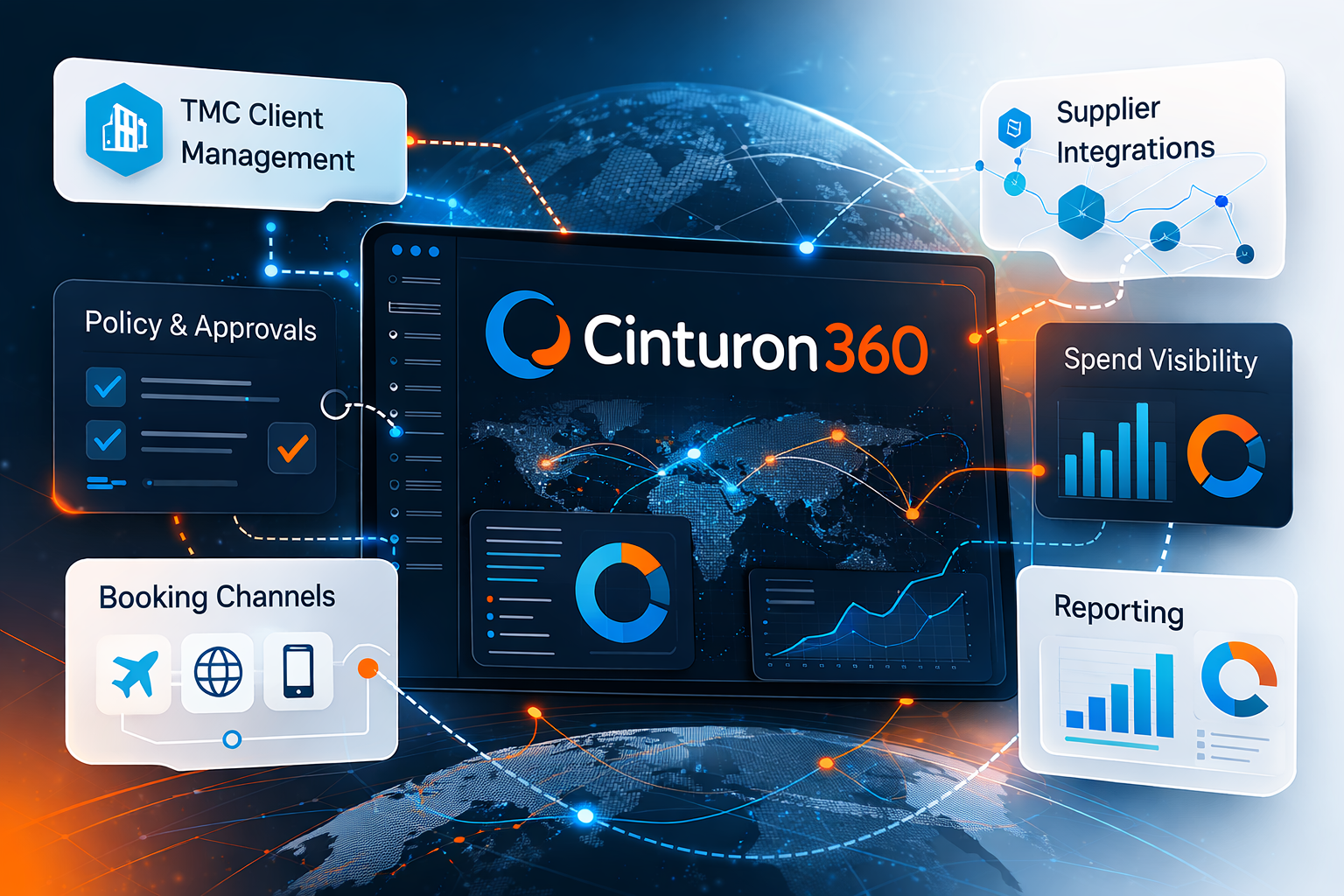
Rather than trying to replace every booking source or force all travel behaviour into a single rigid path, the platform is intended to sit above the existing travel ecosystem and provide structure around it. That includes approvals, policy control, operational visibility, integrations, and finance-grade reporting.
The goal is not to pretend complexity does not exist. The goal is to make it more manageable.
Built for TMCs and their clients
Cinturon360 is being developed with TMCs as a primary operating audience.
That matters, because TMCs are not just managing bookings. They are managing client programs, approval expectations, policy structures, reporting requirements, integrations, servicing models, and operational complexity across multiple accounts.
At the same time, the clients those TMCs support need clearer control over how travel is governed inside their organisation.
That means the platform needs to work for both sides:
- for TMCs that need a stronger operational platform
- for corporate clients that need approvals, policy, and visibility
- for government and controlled environments that need stronger governance and auditability
- for enterprise and growing organisations that need structure without adding unnecessary friction
Cinturon360 is being built to support that shared operating reality.
Why existing travel processes are often not enough
A travel program can look manageable on paper while still being difficult to govern in practice.
A booking might be made through one channel, approved through another process, reviewed against a separate policy interpretation, and reported through a different downstream workflow entirely. That creates unnecessary complexity and often leads to basic questions being harder to answer than they should be.
Questions such as:
- Was this booking approved correctly?
- Was it in policy?
- Who made the decision?
- Was there an exception?
- Which client structure did it belong to?
- How should finance view it?
- How should the TMC report on it?
- What happened across all bookings this month, not just one?
When that level of visibility is missing, governance becomes harder, client servicing becomes harder, and travel operations become more manual than they need to be.
A platform built around governance, not just transactions
Cinturon360 is being built around the idea that managed travel needs stronger governance, not just booking capability.
That means focusing on areas such as:
- policy and approval workflows
- exception handling
- cost allocation and operational routing
- travel and spend visibility
- structured reporting
- integration with the wider travel and business ecosystem
- support for TMC client management and control
These are the areas that often determine whether a travel program is merely functional or actually well managed.
Not a rip-and-replace approach
One of the core ideas behind Cinturon360 is that most organisations do not want, and often do not need, to rip out every existing channel or supplier relationship just to gain more control.
The platform is being shaped to work across the travel ecosystem that already exists.
That means recognising that bookings may originate through different sources, that TMCs may support different client operating models, and that downstream business systems still need structured outputs for finance, procurement, reporting, and oversight.
Cinturon360 is not being built around the assumption of a clean slate. It is being built around the reality of how managed travel actually operates.
Why this matters now
Travel technology has improved in many areas, but many organisations and TMCs still struggle with fragmented control across the lifecycle of a trip.
The issue is not simply access to content or the ability to make a booking. The issue is how that booking is governed, approved, understood, reported, and connected into the rest of the organisation.
That is where a stronger platform layer becomes valuable.
Cinturon360 is being built to help bring those elements together into a more structured and usable operating model.
The direction of the platform
The long-term direction for Cinturon360 is clear.
It is being built to become the platform where TMCs and their clients manage approvals, policy, visibility, integrations, reporting, and operational control across modern travel programs.
That includes the ability to support:
- different client structures
- different approval paths
- different travel policies
- different integration choices
- different reporting expectations
- different servicing models
- different levels of governance maturity
In other words, it is being built for the complexity of real managed travel, not just the simplicity of a demo environment.
Why Cinturon360 is being built
Cinturon360 is being built because managed travel needs a stronger operating layer.
TMCs need better tools to onboard, govern, and service clients.
Client organisations need clearer control over approvals, policy, reporting, and financial visibility.
Modern travel programs need a platform that can sit across the real-world ecosystem rather than ignore it.
That is the role Cinturon360 is intended to play.
It is not being built as another disconnected layer of admin.
It is being built to become the operating layer for modern travel management.